
What if Your Daily Work Was Your Certification Exam?

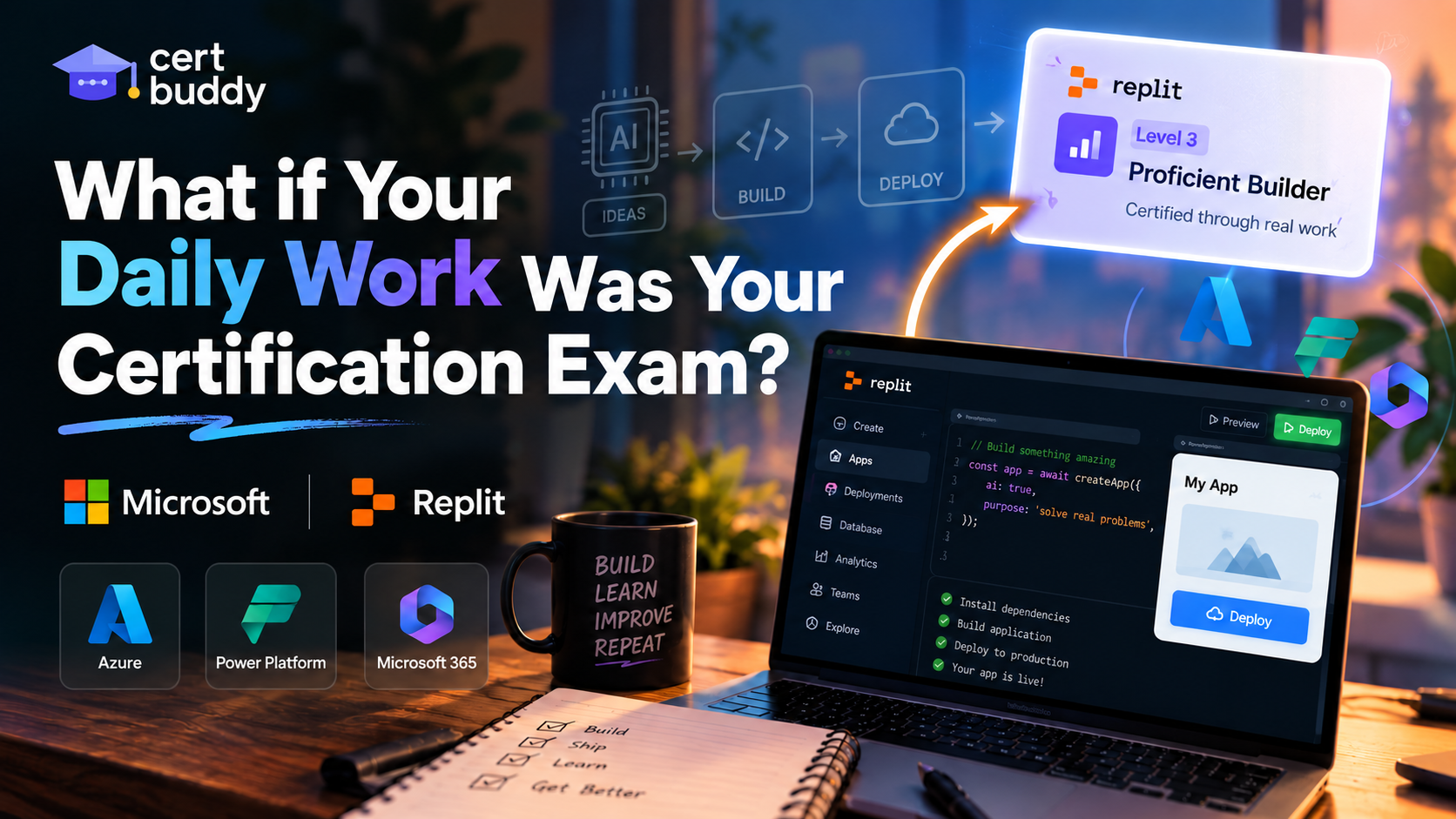
When I worked on certification strategy at Microsoft, we spent a lot of time figuring out how to move past traditional exams to prove someone can actually do the job. Performance-based testing was a big step forward. Instead of answering a multiple-choice question about configuring Azure, we put candidates inside Azure and asked them to do it.
Microsoft took this further with Applied Skills, using interactive labs for Azure, Power Platform, and Microsoft 365. You are using real software, but you are still stepping into a timed, controlled sandbox to prove you can complete specific tasks. Recently, using Replit got me thinking about what comes next.
What if the work itself was the assessment?
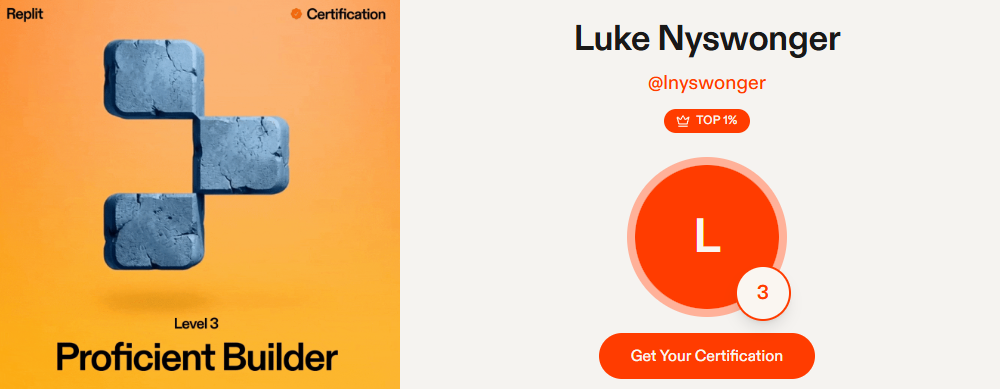
I use Replit regularly to learn AI-assisted development by building real tools. One day, I noticed Replit had certified me as a Level 3 "Proficient Builder." I didn't schedule a test, study a guide, or open a timed lab. I just kept building, and the platform tracked my progress.
That felt fundamentally different. A traditional exam tells you to stop working and prove what you know. A lab test asks you to stop working and prove what you can do. Replit says: keep working, and we will use the work as proof.
Even a great lab is still an event. You launch it, finish the tasks, get a score, and earn a credential. There is nothing wrong with that, especially when you need a controlled environment for consistency. But if a platform already sees that you have deployed dozens of apps and mastered complex architectures, why should it act like it knows nothing about your skills?
Of course, this raises real questions. Replit updates credentials automatically, but it doesn't share a public scoring rubric. Does deploying ten basic apps mean more than building one complex production system? How do you account for AI assistance? An AI agent can help me build something I couldn't write on my own, but that doesn't automatically mean I understand how it works under the hood.
I think about this a lot through my graduate work in Learning Design and Technology. When AI helps us build, we have to ask what we are actually learning. Can you explain your choices, troubleshoot issues, or apply the concept elsewhere? Product activity alone isn't a complete picture.
This hits close to home for me right now as I build Cert Buddy, an AI learning tool for Microsoft certs. I don't want it to be a test-prep engine for memorizing answers. I want to help people understand concepts, practice retrieval, and fix gaps. Traditional certification separates learning from testing, but Replit shows how they can overlap. As you build, evidence accumulates, and your credential evolves with you.
Exams aren't going away (yet), and activity tracking isn't a fix-all for every skill. We still need to address privacy, fairness, and clear rubrics. But skills aren't static snapshots. They grow, shift, and fade over time. A credential that moves with you reflects how expertise actually works.
Maybe the future of credentialing isn't a better test or a realistic lab. It's letting your daily work continuously speak for itself.