
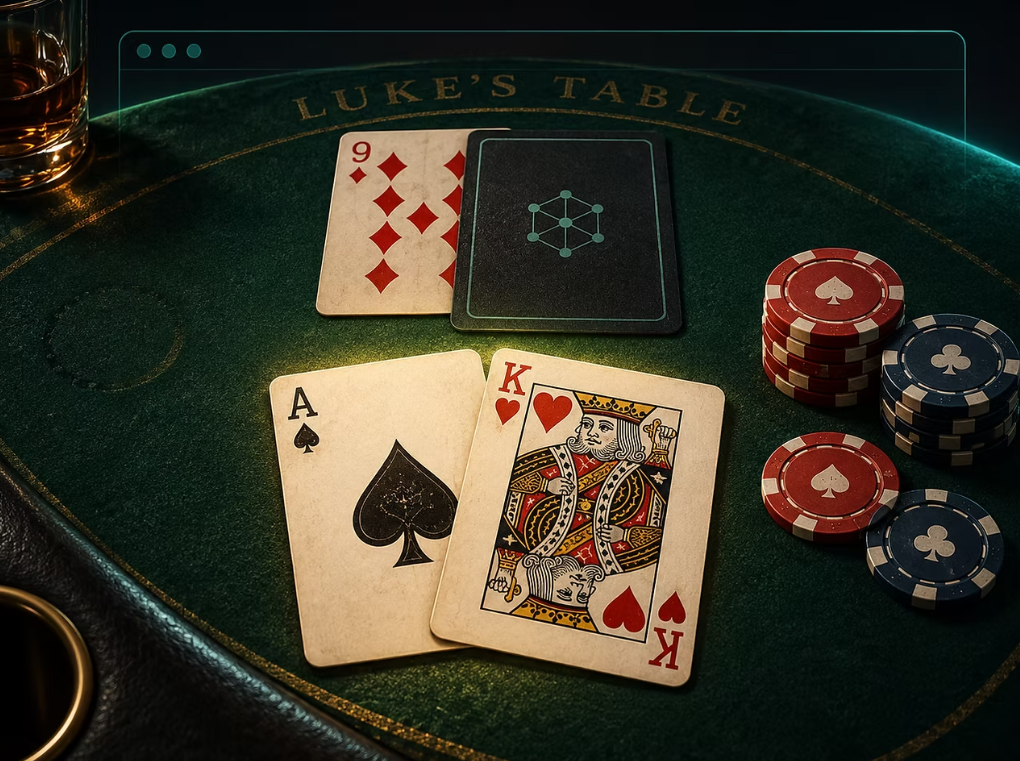
Luke’s Table began as an experiment in interaction, atmosphere, and AI-assisted development. It became an opportunity to design a complete learning experience inside the game itself—one that moves a new player from explanation to supported practice and, finally, independent decisions.
The Design Challenge
Blackjack rules are simple to list but harder to apply in the moment. A useful tutorial needed to teach concepts without separating them from play, provide predictable examples without creating a fake simulation, and offer help without confusing assisted completion with independent understanding.
The solution uses the same cards, controls, hand calculations, and game engine as normal play. Tutorial progress and a $500 practice bankroll remain isolated from the player’s normal game, so experimentation has no consequences outside the learning experience.
Progressive lessons
Estimated learning time
Isolated practice bankroll
Independent-check target
Authored step types
Verification checks passed
Learning architecture
From First Hand to Independent Play
Select a lesson to see how support gradually decreases as the learner builds confidence.
Lesson 1 of 7
Meet the Table
Learn the objective and play a first complete hand with the real table controls.
Instructional system
Five Ways to Learn by Doing
Information
Focused explanations with optional “Why?” expansions.
Quiz
Multiple-choice checks followed by an explanation.
Demonstration
Guaranteed scenarios played through the real game engine.
Decision
Authentic Hit, Stand, or Double choices using only visible information.
Free Play
Normal table controls with a separate practice bankroll.
Authenticity Without Randomness
Authored scenarios are converted into deterministic card shoes and passed through the real Blackjack reducer. Every demonstration therefore produces the intended teaching moment while preserving the same rules and state transitions used during normal play.
Evaluation uses only information visible to the learner—never the dealer’s hidden card or a future draw. Resume state is stored only at stable step boundaries, and resetting progress removes tutorial data without touching the normal bankroll.
Feedback, Evidence, and Accessibility
Guided decisions can offer supportive feedback and a retry. The final check records the first choice and moves directly to feedback. It distinguishes correct independent decisions from assisted ones rather than treating all completion as equal evidence.
- Keyboard shortcuts pass through the same grading logic as on-screen controls.
- Semantic lesson lists, visible focus, touch-sized controls, and live coach announcements support different ways of interacting.
- Phone, tablet, and desktop layouts keep the table and coaching content usable across screen sizes.
- Reduced-motion behavior and explicit disabled states make availability and outcomes clearer.
What I Learned
AI tools accelerated implementation, asset generation, and iteration, but the quality of the experience still depended on playing it, noticing friction, and making deliberate decisions. The most important work was often in the details: preventing hidden-card flashes, separating clicks from drags, enforcing rules in the engine rather than only in disabled buttons, and removing visual elements that felt excessive in context.
The project reinforced a principle that applies well beyond games: clear feedback, authentic practice, understandable controls, and user choice are not finishing touches. They are the experience.