
Published: Nov 21, 2024
Technical content is too often disconnected from the code it describes. By integrating generative AI directly into engineering workflows, we can create accurate, contextual data the moment a system changes.
The Opportunity
Release notes, error messages, and image descriptions are frequently created manually and scattered across source code, engineering tickets, and development systems. This fragmentation causes delays, inconsistencies, knowledge gaps, and accessibility problems.
The opportunity was to stop treating technical-content creation as an isolated, downstream writing task and instead connect it directly to engineering signals—generating the right content exactly when and where the change happens.
My Role
As the inventor and technical content strategist, I developed and documented the core concept and built the initial proof-of-concept code. I partnered with engineering teams to test the approach against internal workflows, and collaborated extensively with Microsoft patent attorneys to formally document the methods and applications.
The Method
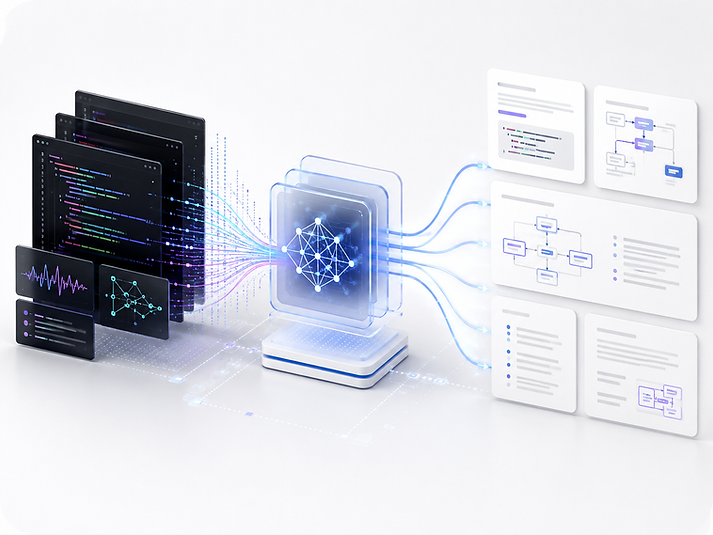
A Repeatable Workflow for Generative Content
The patent defines a closed-loop system embedded within existing developer tools. Select a step below to explore how the automated generation process works.
Detect Signal
Access source code or related development systems to identify a trigger event, such as a resolved engineering ticket, a new error code, or an image missing an alt tag.
System Payload
{
  "event": "state_change",
  "entity": "ticket_8492",
  "new_state": "resolved",
  "source": "devops_board"
}
Applications in Practice
This method allows organizations to scale technical content creation without scaling manual overhead, applying generative AI precisely where it has the most context.
Release Notes
Drafting customer-facing release notes directly from resolved engineering tickets and pull requests.
Error Messages
Writing clearer, actionable error messages by analyzing the surrounding code and failure conditions.
Image Descriptions
Generating highly accurate alt text by combining the image itself with the context of the page it lives on.
Lessons Learned
- Workflow over isolated tools: Valuable AI is embedded in existing workflows. A standalone writing tool is often less effective than intelligence built directly into the engineering pipeline.
- Context is everything: Trusted context and explicit evaluation criteria significantly improve both the quality and the timeliness of the generated outputs.
- Humans remain in the loop: Human judgment remains critical, especially where outputs affect factual accuracy, accessibility standards, or direct customer understanding. The goal is to draft the baseline, not eliminate the expert review.