
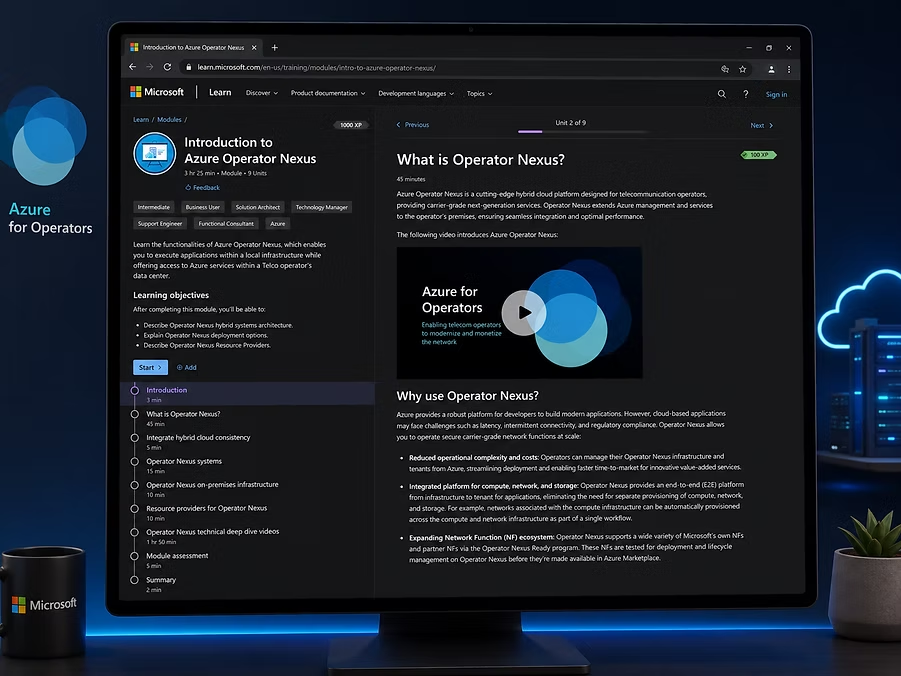
Transforming detailed product specifications and expert knowledge into a clear, structured Microsoft Learn experience without overwhelming the learner.
The Challenge
Azure Operator Nexus is a hybrid cloud platform designed for telecommunications operators. It allows them to run carrier-grade workloads in their own data centers while using Azure services and management capabilities.
The audience for this platform is highly technical: solution architects, technology managers, support engineers, functional consultants, and business users. However, presenting raw product specifications is not the same as teaching. The challenge was to collaborate with Subject Matter Experts (SMEs) to translate dense technical realities into an accessible intermediate learning experience. We needed to bridge the gap between engineering truth and learner comprehension.
My Role
As the co-author and learning-design lead, I partnered directly with the Operator Nexus SME. I led the learning structure, objectives, narrative flow, and assessment design. Beyond writing the content, a core part of my role was enabling the SME to navigate the Microsoft Learn platform and its authoring model.
I also introduced AI-assisted workflows to accelerate narrative drafting and generate initial assessment questions, while ensuring the SME remained the definitive voice for technical validation.
Learning Objectives
Anchoring the Experience
Clear learning objectives were critical to avoid scope creep. We structured the entire module around three verifiable outcomes.
Architecture
Understand hybrid systems architecture.
Deployment
Explain deployment options.
Resources
Describe Operator Nexus resource providers.
Progression
A Nine-Unit Learning Path
The content progressed systematically from high-level models to specific components, embedding media at critical moments of cognitive load.
Collaboration Model
AI, SME, and Learning Design
The development process demonstrated how AI can accelerate content creation without replacing domain expertise.
SME Partnership
SMEs provided the raw engineering reality and technical validation. I coached them through the Microsoft Learn authoring model, shifting focus from exhaustive documentation to targeted instruction.
AI Acceleration
AI was used as a drafting and design partner to build connective narrative tissue and generate initial assessment questions, significantly reducing the blank-page hurdle.
Instructional Review
AI output required rigorous review, restructuring, and alignment with our three learning objectives. The SME remained central for technical accuracy at every stage.
Results
The final deliverable was a public, structured Microsoft Learn module comprising nine units. It successfully incorporated prerequisites, clear objectives, integrated videos to alleviate cognitive load, and a scored assessment leading to Microsoft Learn profile recognition. By designing the content for the platform rather than forcing existing documentation into a module container, we created an experience optimized for how technical professionals actually learn.
Lessons Learned
- Alignment is everything: Learning objectives, instructional narrative, media placement, and assessment questions must be deliberately aligned. If a concept isn't stated in an objective, it shouldn't dictate the assessment.
- Enable the expert: Teaching SMEs the learning-development process is just as important as writing the content. An empowered SME becomes a better instructional partner.
- AI as a partner, not a replacement: AI accelerates initial narrative and assessment drafts, but it absolutely requires human review, restructuring, technical validation, and strict alignment to objectives.