
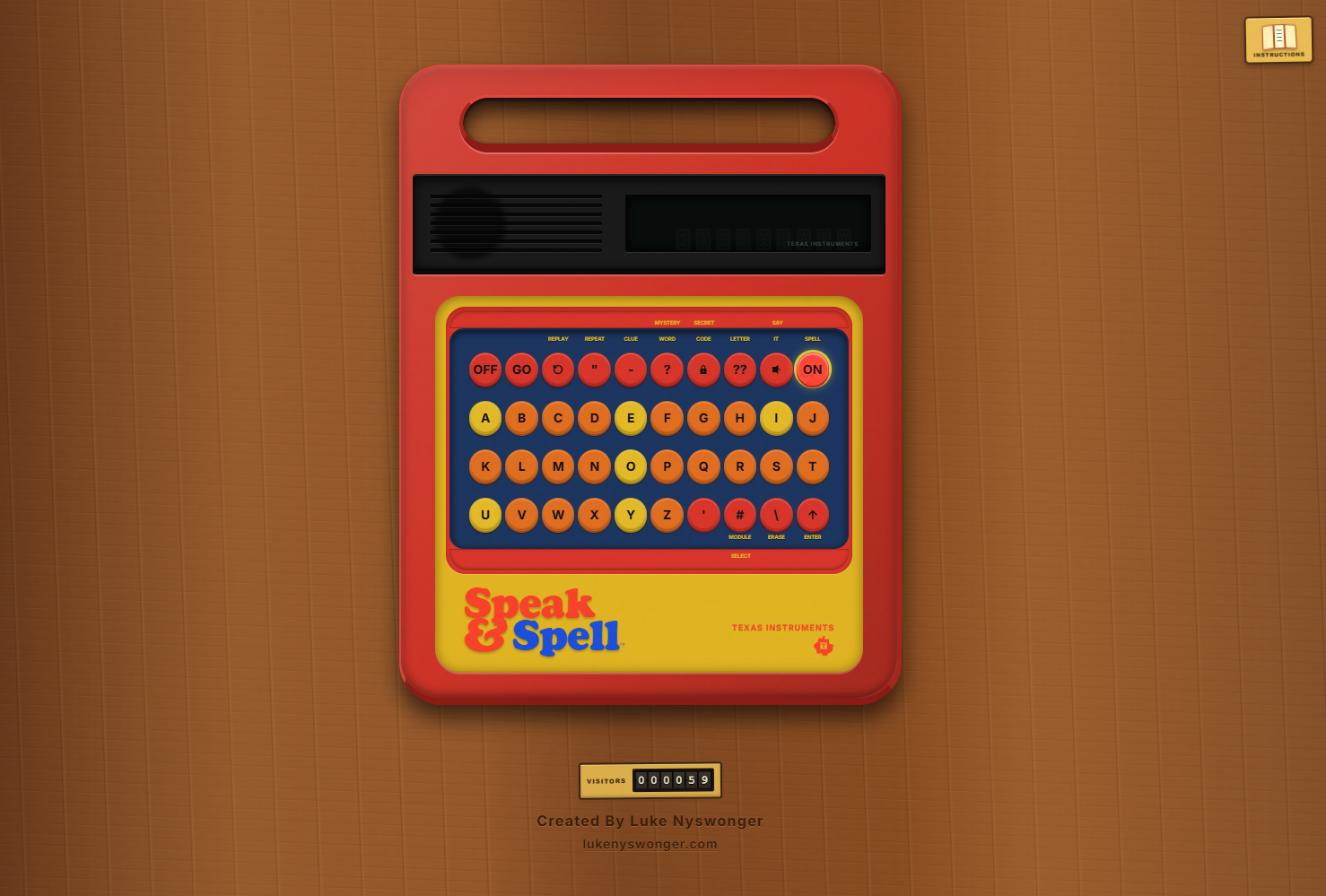
A childhood memory and an unfinished Flash recreation prompted a simple question: what would it take to rebuild the complete Speak & Spell experience with today’s AI tools?
Curiosity as a Starting Point
The project began without a roadmap or business case. It was a curiosity-driven experiment designed to make a familiar object interactive again—and to understand what AI-assisted development changes about the process of turning an idea into a working artifact.
ChatGPT supported research, visual critique, and interaction ideas. Claude Code supported implementation and iteration. A recognizable first version appeared quickly, but recognition was not the same as fidelity. The project became an exercise in observing closely, identifying why something felt wrong, and refining both appearance and behavior.
Assisted implementation
Speech synthesis
Browser sound
Responsive interaction
Experiment loop
From Fast Prototype to Faithful Experience
Select a stage to see how the work shifted from code generation to observation, analysis, and judgment.
Build a Fast Baseline
AI made it possible to move quickly from a nostalgic idea to a recognizable red chassis, yellow keyboard, digital display, and working controls.
Key insight
Speed created something concrete enough to evaluate instead of leaving the idea in a “maybe someday” list.
Learning by building
Questions the Project Forced Me to Answer
Speech synthesis
Giving the recreation a voice and making spoken feedback part of the interaction.
Web Audio
Understanding browser-based sound behavior rather than treating audio as decoration.
Segmented displays
Recreating the visual constraints and character of the original digital readout.
Responsive interaction
Adapting a physical-toy interface so it remains usable across screens and input methods.
Vintage industrial design
Studying molded plastic, color, spacing, and proportion closely enough to capture the original experience.
Task analysis
Defining how a learning function behaves before asking AI to implement it.
Task Analysis Hidden Inside a Button
The CLUE button initially looked correct but did nothing. Making it work required more than attaching an event: I had to understand the original learning task. When was a clue available? What did it reveal? Did using it count as a missed attempt? What feedback did the learner receive?
Those questions are task analysis. AI could generate an implementation quickly, but it could not define the desired experience without a clear model of the behavior first. Building the wrong thing faster would not have been progress.
What Cheap Experimentation Changes
AI dramatically reduced the cost of trying an idea and revising it. That lower cost made it reasonable to ask more questions, compare more alternatives, and follow unexpected learning paths through audio, animation, responsive design, display technology, and industrial design.
The project reinforced that human judgment does not disappear when implementation accelerates. It becomes more important. Someone still has to notice the mismatch, articulate the problem, choose what matters, test the result, and decide whether the experience is actually better.