
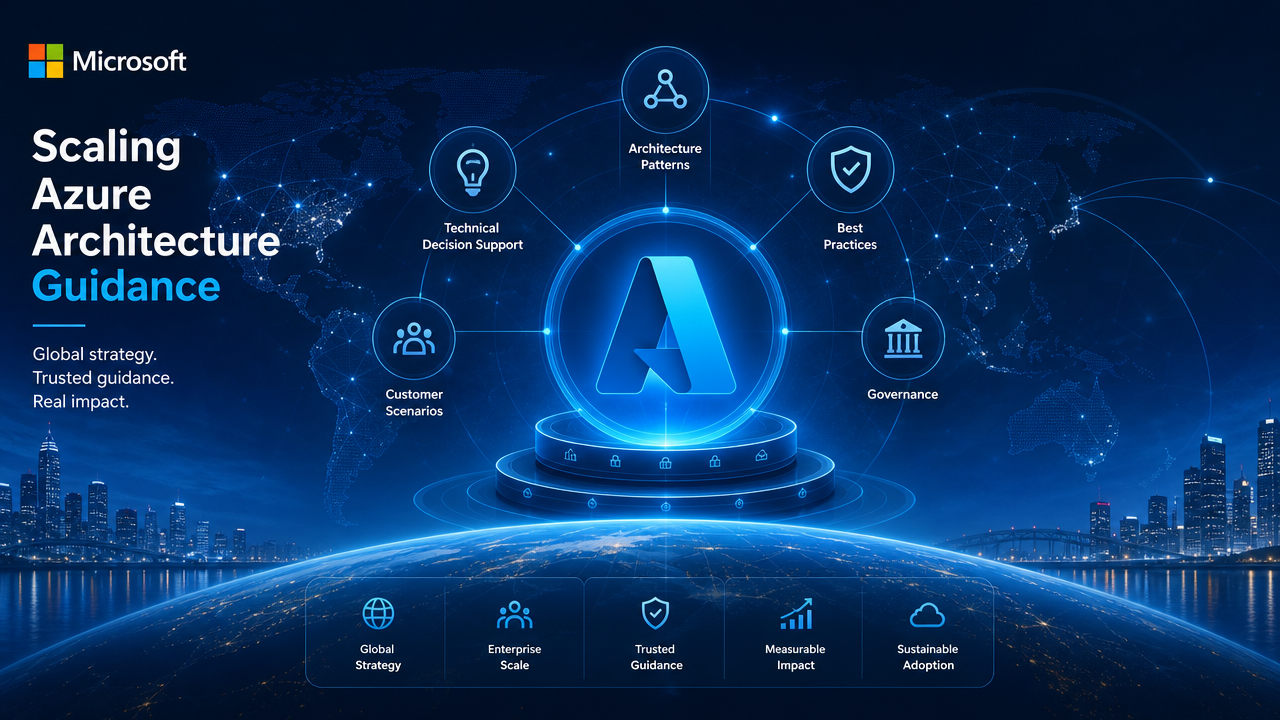
Azure customers relied on several major guidance portfolios to make architecture, adoption, migration, and reliability decisions. The leadership challenge was not to centralize those portfolios under one owner, but to help them operate as a more connected system.
The Opportunity
Each portfolio had its own history, audience, stakeholders, and lead. The organization needed stronger alignment with Azure priorities, more delivery capacity, deeper relationships with engineering and customer-facing teams, and a scalable way for experts across Microsoft to contribute authoritative guidance.
I led the multidisciplinary Azure Patterns & Practices organization across the United States, Ireland, and New Zealand. My responsibility was the health of the overall portfolio and organization: supporting portfolio leaders, establishing shared priorities, developing talent, removing barriers, making investment decisions, and translating broad Azure priorities into executable plans.
Portfolio system
Connected Guidance, Distinct Ownership
Explore the portfolios that helped customers move from cloud strategy through architecture, migration, optimization, and reliability.
Azure Architecture Center
Patterns, reference architectures, and decision guidance for designing solutions on Azure.
Portfolio contribution
A core portfolio in the connected architecture-guidance system.
Leadership approach
Scale Through Teams and Systems
Build the organization
Established and grew a new team presence in Ireland while integrating writers, engineers, managers, and PMs across the United States, Ireland, and New Zealand.
Steer migration strategy
Helped define and champion a twelve-month strategy for a more coherent Azure Migration Hub experience and its first priority scenarios.
Renew contribution
Authored a strategy for combining distributed technical expertise with central standards, governance, editorial support, and publishing systems.
Improve portfolio health
Used freshness and portfolio data to identify aging content, prioritize updates, and make maintenance risk more visible.
Improving Portfolio Health
The organization used portfolio data to identify aging content, prioritize updates, simplify large guidance sets, and improve visibility into maintenance risk. Architecture-content freshness increased from roughly 35 percent to more than 70 percent in aggregate over approximately eighteen months.
I also encouraged experimentation with AI-assisted authoring, contributor tooling, dashboards, and workflow improvements. The goal was to reduce repetitive manual work and give teams more time for high-value architecture guidance and customer needs.
Results
- Expanded global capacity through new hiring and team development in Ireland.
- Added the Reliability Hub and Azure Migration Hub to the portfolio.
- Launched the initial Migration Hub experience and more than ten priority scenarios.
- Improved architecture-content freshness and portfolio-health visibility.
- Strengthened connections with engineering, marketing, field, and customer-facing organizations.
- Advanced contributor strategy and more scalable content operations.
Lessons Learned
Portfolio leadership requires creating alignment without erasing ownership. The strongest results came when portfolio leads retained authority over their businesses while the broader organization supplied shared direction, staffing, standards, data, and connections.
Architecture guidance cannot scale through central production alone. It needs distributed technical expertise combined with strong governance and editorial support. The work also reinforced that senior leadership does not always produce a neat endpoint; sometimes the result is momentum, a clearer direction, and a stronger foundation for the next team.