
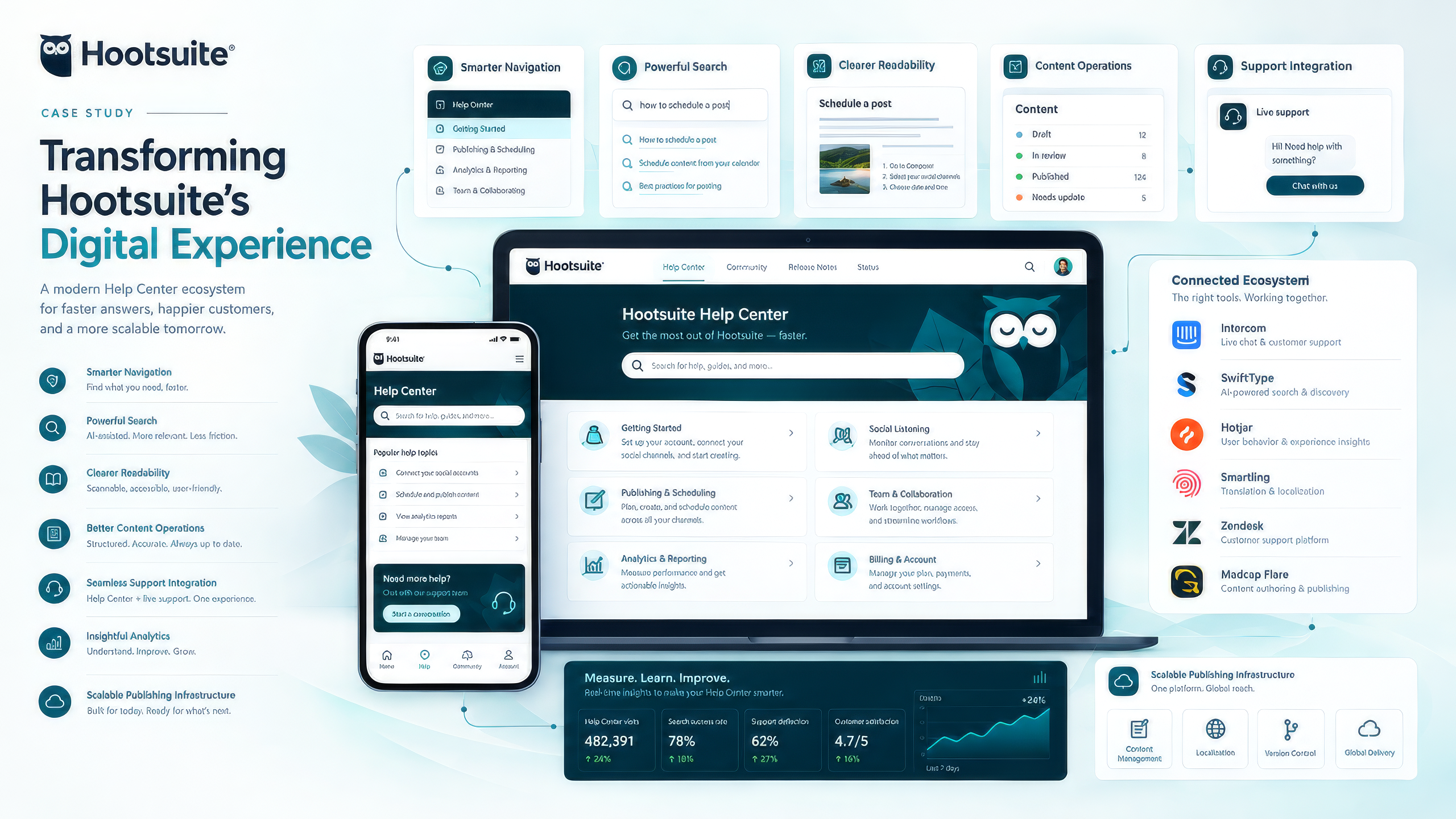
The Hootsuite Help Center was a critical part of the customer experience for a platform serving more than 18 million customers. Its content reached beyond the website into support workflows, conversational tools, and in-product experiences.
The Challenge
The existing Zendesk-based model worked well when a small group of support advocates created content, but Hootsuite’s growth required a more scalable, measurable, and reusable approach. Customers faced limited navigation and challenging readability. Internally, knowledge was difficult to discover, and the publishing model lacked the version control, localization, and automation capabilities needed by a growing content organization.
I led the evolution of the Help Center experience and its supporting content infrastructure, balancing immediate customer improvements with the design of a longer-term content platform.
Customers relying on the platform
Support cases using Help Center content
Accessibility target advanced
Single-source authoring environment
Version control adopted for content
Channel publishing architecture
Process
Phased Transformation
Improving the current experience and designing the future platform do not need to be competing priorities. We used a phased roadmap to create immediate customer value while building the long-term system.
We began with internal and external research, partnering with support and testing the existing Help Center with customers to identify immediate and longer-term needs.
Infrastructure
Connected Content Ecosystem
A Help Center is not simply a collection of articles. The new architecture decoupled creation from delivery, establishing a true omnichannel content engine.
Authoring
MadCap Flare provided a more mature authoring environment and made content more portable and reusable than authoring directly in the delivery platform.
- Scalable authoring environment
- Reusable source content
- Multi-channel publishing foundation
Outcomes & Impact
The Help Center evolved from a platform-bound publishing experience into a flexible content ecosystem. Customers gained clearer navigation, improved readability, richer support pathways, stronger brand alignment, and continued progress toward WCAG 2.1 AA.
The content team gained structured authoring, version control, automated builds, localization workflows, and the ability to publish reusable content directly to the Help Center, conversational support, and in-product experiences without duplicating effort.
Lessons Learned
- Content is an ecosystem: A Help Center is shaped by technology, search, accessibility, localization, analytics, and support workflows working together.
- Balance now and next: Delivering immediate value on the legacy platform built trust and bought time to architect the future system correctly.
- Requirements over platforms: Technology selection works best when it begins with rigorous customer, author, and business requirements—not a preferred brand name.
Read the full story