

Repositioned Office developer content around engineering alignment, code-first learning, docs as code, and a more integrated cross-platform developer journey.
Context
Office was evolving from a traditional desktop-product ecosystem into a cloud and services platform spanning Office 365, APIs, mobile devices, and multiple development environments. Developer guidance remained fragmented across MSDN, dev.office.com, product-specific sites, API references, samples, and legacy documentation while customers increasingly needed coherent, cross-platform solutions.
Engineering investment in Office 365 APIs, OneDrive, OneNote, Outlook, Android, and iOS was accelerating while content resources were declining. The organization needed a new operating model, a modern publishing approach, and a much closer relationship with the product teams building the platform.
Role
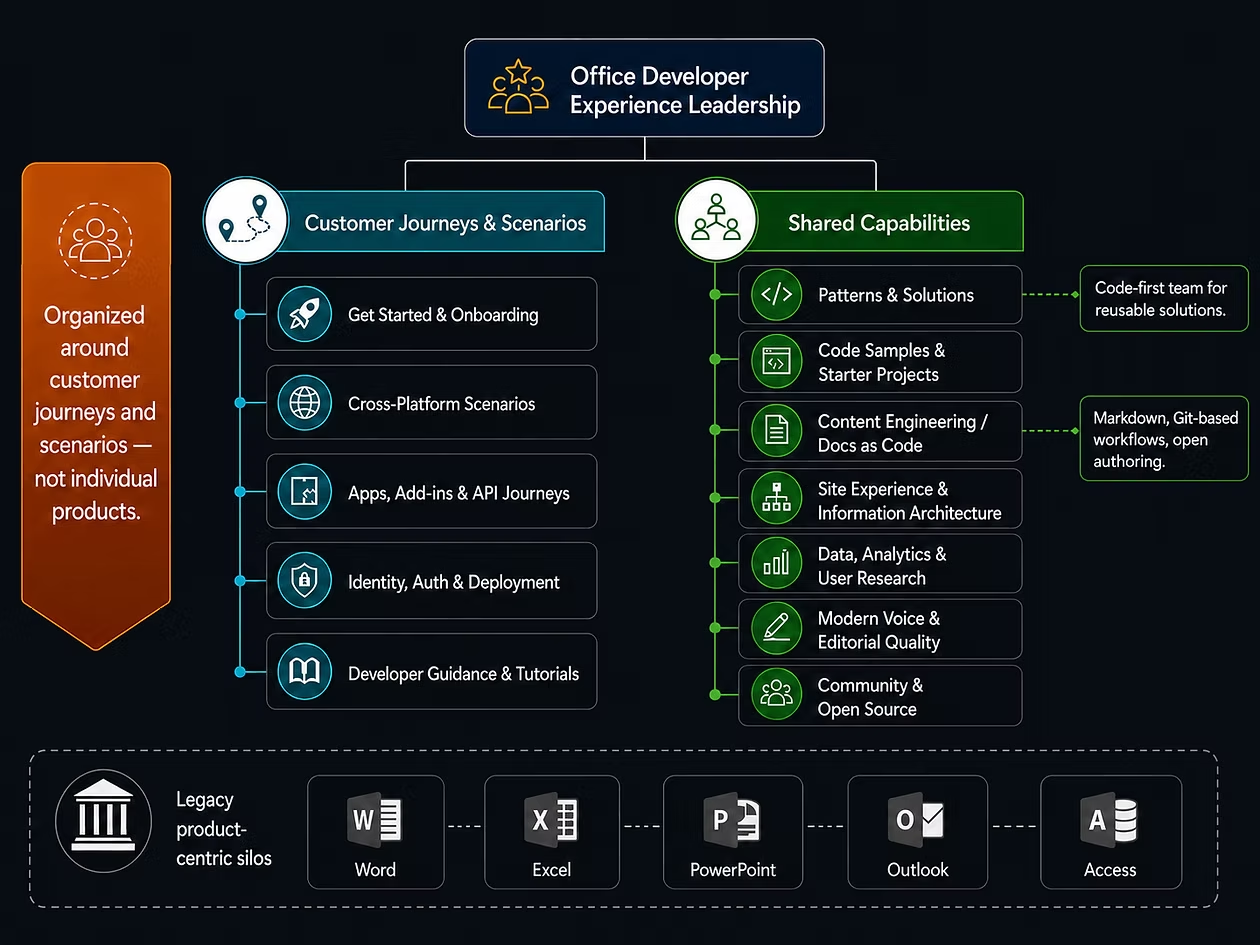
I led a team responsible for major Office developer-content experiences and helped drive a broader transformation of the organization. I created a new Patterns and Solutions team focused on reusable code, starter projects, reference applications, and practical solutions. I also helped reposition the content organization within engineering so developer education could become part of product development rather than a downstream publishing activity.
- Creating and leading the Patterns and Solutions team for code-first developer learning
- Moving the organization closer to engineering roadmaps, APIs, releases, and technical decisions
- Leading information-architecture and developer-site improvements
- Establishing code-sample standards and integrating customer research into planning
- Guiding the transition toward Markdown, GitHub, open authoring, and docs-as-code workflows
- Redesigning team structures, charters, leadership roles, and investment priorities around developer outcomes
Approach
The transformation combined organizational design, content strategy, engineering integration, and publishing modernization. We shifted investment from isolated product documentation toward reusable patterns, cross-platform samples, starter projects, and end-to-end solutions that helped developers learn by building.
The Patterns and Solutions team created code-centric experiences across Android, iOS, Windows, Windows Phone, and the web, reflecting how developers increasingly worked across products and platforms.
The organization adopted Markdown, GitHub-based workflows, open authoring, and closer alignment with engineering release processes so content could be reviewed, versioned, updated, and maintained alongside the product.
Portions of the VBA documentation were opened to community contribution—an early experiment in treating technical documentation as a shared, open-source asset.
The organization was redesigned around developer experiences and horizontal capabilities, including Patterns and Solutions, content engineering, site experiences, analytics, user research, and data.
Outcomes
Office developer content shifted from a fragmented, publication-centered model toward a more integrated developer-experience organization.
Closer engineering alignment improved visibility into product roadmaps, APIs, release schedules, and platform priorities.
The Patterns and Solutions team introduced a stronger code-first model with practical assets for adopting Office services across multiple platforms.
Markdown, GitHub, open authoring, and docs-as-code practices began replacing traditional publishing workflows, while selected community contributions demonstrated a new way to maintain mature technical content.
The broader experience improved through clearer navigation, stronger getting-started content, more consistent sample standards, greater use of customer data, and consolidation around dev.office.com.
Lessons Learned
Developer content is part of the product, and the organization producing it should be closely connected to engineering.
Technical-content teams create more value when they combine writing, code, design, analytics, research, and platform thinking.
Developers often learn best through working examples and complete solutions, not isolated documentation alone.
Docs-as-code tools improve transparency and collaboration, but transformation succeeds only when people understand the purpose, gain the necessary skills, and can connect their work to customer outcomes.